Auto Body & Paint

Auto Body & Paint in Beverly Hills.

Panel repair, refinishing, and paint matching on finishes that are difficult to match — metallics, pearls, tri-coats, and factory matte.

Auto Body & Paint at HADD Customs in Beverly Hills

The paint code on your door jamb identifies a formula, not the color of your car. Between factory batch variation, the plant that sprayed it, and the years of Southern California sun that have been working on it since, the same code produces a visible range of real-world colors. Matching is done on the car, in daylight, or it is not really being done.

That principle drives everything in our body and paint department: spray-out cards before anything touches the vehicle, let-down panels on tri-coats, blending into adjacent panels rather than hard edges, and a final look at the car outside before we call it finished.

Call (310) 988-2848

Body work before paint

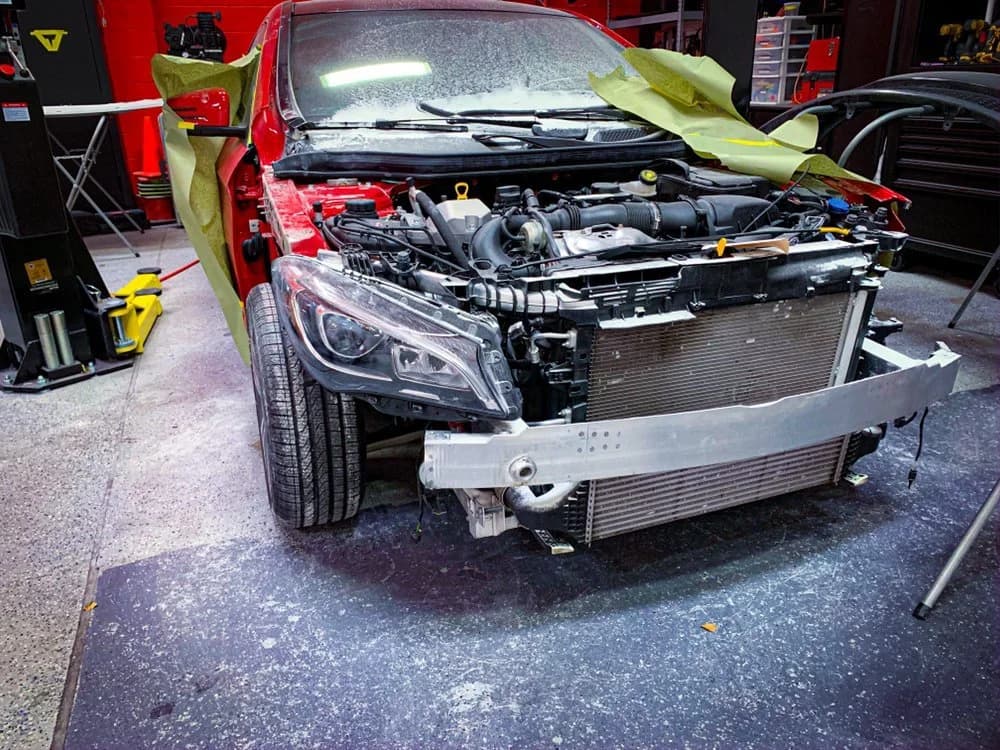
Good paint over poor metal work is a repair that announces itself in the first hour of afternoon sun. Panels are worked back to shape with minimal filler, edges and body lines restored to their original geometry, and gaps set to match the panels around them — on a luxury car the eye notices a gap that varies by a millimetre, because nothing else on the car does.

Where a panel is beyond sensible repair, or where the manufacturer restricts repair, we replace it. That decision is driven by the metal's condition, the manufacturer's procedure, and the durability of the result — not solely by whichever is cheaper on the estimate.

Matching difficult finishes

Metallics require matching both the color and the way the flake lies, which is a function of gun setup, pressure, distance, and flash time. Tri-coats — Mercedes-Benz designo finishes, Ferrari's three-stage reds and whites, most premium pearl whites — have a translucent mid-coat whose final color depends on how many coats were applied, so they are matched with a let-down panel that shows exactly how many produce your car's color.

Every match is evaluated under corrected daylight lamps and again in actual sunlight, because two colors built from different pigments can look identical under one light source and clearly different under another. If a shop only ever checks a match indoors, you will be the one who discovers the problem.

  • Spray-out cards before any paint reaches the vehicle
  • Let-down panels for tri-coat and pearl finishes
  • Blending into adjacent panels so there is no hard transition line
  • Factory matte and satin finishes handled with the correct product system
  • Clear coat restoration on sun-damaged roofs, hoods, and decklids
  • De-nib and polish, then a daylight inspection before delivery

Full repaints and color changes

We repaint complete vehicles, including color changes with jambs, and we will tell you honestly when a vinyl wrap is the better answer — on a car whose factory paint is healthy and whose value depends on originality, a reversible wrap usually is.

For sun-damaged clear coat, which is one of the most common paint problems in Los Angeles, the correct repair is panel-level refinishing rather than polishing. Compounding a delaminating roof buys a few weeks of appearance and costs you the little clear coat that remained.

FAQ

Auto Body & Paint — common questions

Why does the estimate include painting the panels next to the damage?
That is blending, and it is standard practice rather than padding. Paint matching is never absolutely perfect — it is good enough to be invisible across a gradual transition, and rarely good enough to survive a hard edge where the eye compares two values an inch apart. Blending puts the transition in the middle of an adjacent panel where nothing draws attention to it.
Can you match my tri-coat or designo paint?
Yes. Tri-coats are matched with a let-down panel — a test card sprayed with a progressively increasing number of mid-coats — so we can see exactly how many produce your car's color and then replicate that count on the vehicle. It takes longer than a standard match, and it is the only reliable way to do it.
When can I wash or wax my car after a repaint?
Hand wash only for the first two weeks, and no wax, sealant, or ceramic coating for 30 to 60 days. Fresh paint is still releasing solvent through the film, and sealing the surface too early traps it. Avoid automatic car washes entirely during that window.
My clear coat is peeling on the roof. Can it be polished out?
No. Peeling and hazing mean the clear coat has structurally failed, and polishing removes more of the little that remains. The correct repair is refinishing the affected panels back to a sound substrate. Addressing it early matters, because once the clear starts lifting at an edge it spreads.
Do you do complete repaints and color changes?
Yes, including jambs. We will also tell you when a vinyl wrap would serve you better — on a car with healthy original paint, a reversible color change protects value in a way a repaint does not.
Begin

Bring your vision
to life.

Free estimates, rental cars, towing, and direct insurance handling. Call HADD Customs in Beverly Hills to schedule.

Call (310) 988-2848
Get In Touch

How would you like to begin?

Text us for the fastest answer, or send your details and we'll get back to you with a free estimate.

Send a message now

Or call us directly at (310) 988-2848