Porsche Specialists

Porsche Collision Repair in Beverly Hills.

Aluminum-intensive bodywork, rear-engine geometry that has to be measured rather than eyeballed, Taycan high-voltage procedure, and Paint to Sample matching — from an I-CAR Platinum shop 25 years into this work.

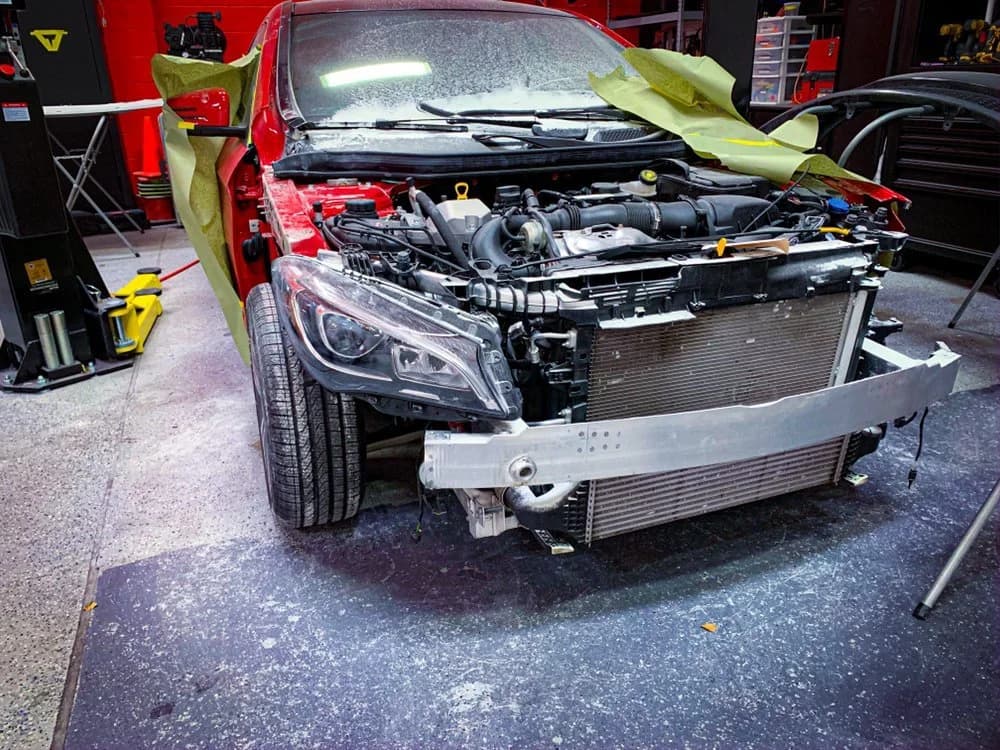
Front-end collision repair in progress at HADD Customs in Beverly Hills

Porsches get driven, which is the first thing worth saying about repairing them. The cars that arrive here are not garage ornaments — they are 911s with canyon miles on them, Macans doing the school run on Sunset, Taycans that have never seen a gas station. The damage reflects that: front lips scraped on driveways, wheels curbed against Beverly Hills gutters, and the occasional serious hit on the 405.

What makes the repair specific is construction. A 992-generation 911 body is aluminum-intensive with high-strength steel where crash energy has to be managed, joined by rivets and structural adhesive as much as by welds. The engine hangs behind the rear axle, so rear structural damage changes how the car behaves at speed in a way a front-engine sedan simply does not. None of that is guesswork territory.

Call (310) 988-2848

Aluminum, high-strength steel, and where they meet

Porsche builds in mixed materials and specifies exactly how each joint goes back together. Aluminum outer panels over steel structure, aluminum castings at suspension mounting points, ultra-high-strength boron steel in the pillars and rockers — and each of those has different rules about heat, about welding, and about whether a section repair is allowed at all.

Aluminum work happens in a separated area with dedicated tooling. Steel dust that settles onto aluminum embeds in the softer metal and starts galvanic corrosion, which surfaces as blistering under the paint a year or two later. Rivets are single-use, structural adhesive has a specified open time and cure, and every dissimilar-metal interface gets the anti-corrosion treatment the procedure calls for.

Boron steel is the one that catches shops out. Its strength comes from heat treatment during manufacturing, so a torch used to straighten a pillar destroys that strength locally while leaving the panel looking perfect. The procedure says replace, not straighten, and we follow it.

  • Separated aluminum area with dedicated tooling and consumables
  • Riveted and bonded joints assembled per the factory procedure
  • Three-dimensional structural measuring, before and after
  • Boron steel replaced rather than heat-straightened
  • High-voltage shutdown and isolation checks on Taycan
  • Corrosion protection, seam sealer, and cavity wax restored

Rear-engine geometry and why measuring is not optional

On a 911 the mass sits behind the rear axle, and the car's behavior depends on suspension pickup points being exactly where Porsche put them. A rear impact that looks like bumper and quarter-panel damage can move a mounting point a few millimeters, and a few millimeters is enough to change how the car rotates on turn-in. The owner feels it before any warning light mentions it.

So structural work is measured in three dimensions against the manufacturer's specification before anything is pulled, corrected with anchored sequential pulls, and re-measured until it reads in tolerance. You get the before-and-after printout. On a car that is going to be driven properly, that document is worth more than a clean-looking panel gap.

Taycan: 800 volts, and a floor that is part of the structure

The Taycan runs an 800-volt architecture, roughly double what most electric vehicles use, and the battery sits in the floor as a structural member rather than a box bolted underneath. Body repair on one starts with the documented high-voltage shutdown and isolation procedure, and it does not start until that is verified.

The pack's location also changes what counts as significant damage. An underbody strike, a side impact into the sill, or a hard hit to the rocker are all events with a defined inspection requirement, because enclosure deformation matters even when the car drives away and shows no fault. Where Porsche's procedure calls for pack service or evaluation beyond what an independent shop may perform, we say so plainly and route that part of the work accordingly rather than working around it.

Underneath the electric drivetrain the rest is familiar territory: aluminum-intensive body, camera and radar systems that need recalibration, and paint that has to be matched to a car that lives outdoors in Southern California.

Paint to Sample, and the colors nobody stocks

Porsche owners spec color more deliberately than almost anyone else. Paint to Sample and Paint to Sample Plus produce finishes that are frequently absent from the standard refinish databases, and even the catalogue colors include some genuinely difficult ones — Chalk reads differently under every light source, GT Silver is all about flake orientation, and the pearl and metallic whites change with the number of coats applied.

Every match starts with a spray-out card, not with a code. For multi-stage colors we build a let-down panel to establish how many mid-coats produce your car's actual color, then replicate that count on the vehicle. The result is checked under corrected daylight lamps and again in real sunlight, and blended into the adjacent panels rather than sprayed to a hard edge.

If your car wears a Paint to Sample color and the original formula is not obtainable, we will tell you that at the estimate — along with what it means for which panels need to be refinished — instead of discovering it after the car is in primer.

Wheels, lips, and the damage Los Angeles does

Two things happen to Porsches here more than anywhere else. Wide rear wheels meet Beverly Hills curbs, and low front lips meet driveway aprons. Both are repairable in-house: wheel refinishing on curb rash and lip damage, and front bumper and splitter work that does not require replacing an entire assembly for a scrape.

For cars that keep meeting the same driveways, paint protection film on the nose, mirrors, rockers, and rear quarter leading edges is the cheapest insurance available. On GT models with exposed carbon aero, film over the carbon is worth more still — clear coat over weave yellows under UV faster than paint does, and Southern California is unusually hard on it.

Models we work on

911 in its Carrera, Turbo, Targa, and GT forms, 718 Cayman and Boxster, Panamera, Macan, Cayenne including the Coupe, and the Taycan range. Older water-cooled and air-cooled cars come through too, where the conversation shifts toward originality and how much of the existing paint can be preserved.

Alongside collision work we do wheel refinishing, paint protection film, ceramic coating, color change wraps, and full customization on Porsches — every one of those performed in-house at the same Beverly Hills shop rather than sublet out.

FAQ

Porsche collision repair — common questions

Do I have to use a Porsche dealer body shop?
No. California Insurance Code section 758.5 gives you the right to choose your repair facility, and your insurer pays either way. What actually matters is whether the shop pulls the Porsche repair procedures for your VIN, has separated aluminum equipment, and recalibrates the driver-assistance systems afterward. Where a repair genuinely requires a manufacturer-authorized path — certain restricted structural components, or high-voltage battery pack service on a Taycan — we will tell you rather than attempt it.
Can you repair the aluminum bodywork on a 992 or Panamera?
Yes. Aluminum work is done in a separated area with dedicated tooling, joined with the rivets, flow-drill screws, and structural adhesive the factory procedure specifies rather than welded where welding is not permitted, and straightening heat is kept inside the specified range because overheating aluminum permanently weakens it. Anything the procedure prohibits repairing gets replaced at the factory joint.
Do you work on the Taycan?
Yes, for body and collision work. The Taycan's 800-volt system is shut down and isolated per the documented procedure before any body repair begins, and its floor-mounted battery is a structural member, so underbody and rocker impacts carry a defined inspection requirement even when the car shows no fault codes. Where Porsche's procedure requires battery pack service beyond an independent shop's scope, we say so and route that portion appropriately.
Can you match a Paint to Sample color?
In most cases, yes — but we establish that before the car is disassembled rather than after. Paint to Sample colors are often absent from standard refinish databases, so matching relies on spray-out cards and, for multi-stage finishes, a let-down panel to find the exact mid-coat count. If a particular formula cannot be obtained we will tell you at the estimate and explain what it means for the repair plan.
Will my Porsche's driver-assistance systems still work correctly?
Yes, because they are recalibrated and the calibration is documented. Front camera, radar, park sensors, and surround-view cameras all have aim tolerances measured in fractions of a degree, and bumper work, windshield replacement, mirror replacement, or any ride-height change can each trigger a calibration requirement. A scan with no fault codes does not prove a camera is aimed correctly.
How long does a Porsche repair take, and what drives the timeline?
Cosmetic work is usually three to five days, single-panel repairs one to two weeks, and structural repair with calibration four to eight weeks or more. Parts availability is almost always the constraint rather than shop capacity — GT-model and Paint to Sample components in particular ship from Germany on the factory's schedule. We give you an honest range at the estimate and tell you the week a date slips, not at the end.
Begin

Bring your vision
to life.

Free estimates, rental cars, towing, and direct insurance handling. Call HADD Customs in Beverly Hills to schedule.

Call (310) 988-2848
Get In Touch

How would you like to begin?

Text us for the fastest answer, or send your details and we'll get back to you with a free estimate.

Send a message now

Or call us directly at (310) 988-2848