Range Rover & Land Rover Specialists

Range Rover Collision Repair in Beverly Hills.

All-aluminum bodies repaired the way they were assembled — riveted and bonded, not welded — plus air suspension and ADAS recalibration, from an I-CAR Platinum shop.

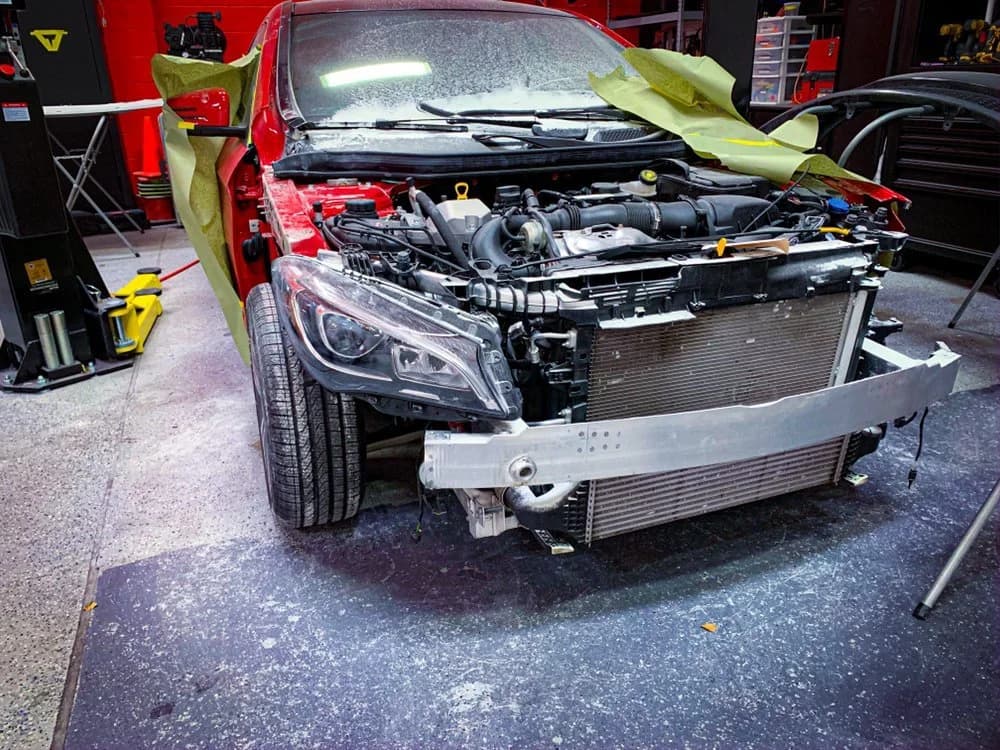
Front-end collision repair in progress at HADD Customs in Beverly Hills

The single most important thing about repairing a current Range Rover is that its body is essentially all aluminum, and it was not welded together. The structure is joined with self-piercing rivets and structural adhesive, which is a fundamentally different assembly process from the spot-welded steel unibody most collision shops are set up for — and a shop without the right equipment cannot put one back together correctly no matter how skilled its technicians are.

That construction runs across the modern range: Range Rover, Range Rover Sport, Velar, Evoque, Discovery, and the current Defender. It is why these vehicles are as light as they are for their size, and it is why the repair procedure is unusually prescriptive about which rivet goes where and which adhesive bond may be broken at all.

Call (310) 988-2848

Riveted and bonded aluminum, not welded steel

On an aluminum-intensive Land Rover structure, self-piercing rivets hold the panels in position and structural adhesive carries load across the joint. Both are specified precisely: rivet type and length by location, adhesive product, surface preparation, open time, and cure. Rivets are single-use and are drilled out and replaced rather than reused, and the procedure names which bonded joints may be separated at all.

All of that happens in a separated aluminum area with dedicated tooling and consumables. Steel particles that settle onto aluminum embed in the softer metal and start galvanic corrosion, which surfaces as blistering under the paint a year or two after the repair — long enough that nobody connects the two.

Structural work is measured in three dimensions against the factory specification before anything is pulled and re-measured until it reads within tolerance. Straightening heat is measured rather than judged, because aluminum permanently anneals above its specified range while giving no visual indication that it has.

  • Self-piercing rivets replaced to specification, never reused
  • Structural adhesive applied per procedure, with full cure observed
  • Separated aluminum area with dedicated tooling
  • Three-dimensional structural measuring, before and after
  • Air suspension ride height set before ADAS calibration
  • Corrosion protection and cavity treatment restored

Aluminum panels dent differently

Aluminum has far less elongation than steel and work-hardens quickly as it moves, which changes what is repairable. A dent that would come out of a steel door with paintless dent removal frequently will not come out of an aluminum one — the metal has no memory to work with, and pushing it harder just work-hardens it further and cracks the paint.

That is not a reason to replace every damaged panel, but it is a reason to evaluate honestly rather than optimistically. We will tell you when a panel is genuinely repairable and when the attempt is going to produce something you can see in a reflection, which on a large flat surface like a Range Rover door is unforgiving.

Air suspension, ride height, and calibration order

Almost every vehicle in this range rides on air suspension with multiple selectable heights, and that interacts directly with the driver-assistance systems. Forward camera and radar aim are referenced to the vehicle's ride height and thrust line, so calibrating a camera on a car sitting at the wrong height produces a system that is confidently wrong.

The order therefore matters: structure measured back into tolerance first, then alignment, then ride height set to specification, then camera and radar calibration. Doing those out of sequence produces a car that passes each individual check and behaves incorrectly on the road.

The systems involved are the usual full set — forward camera behind the windshield, forward radar, corner radar for blind-spot and cross-traffic warning, ultrasonic sensors, and the multi-camera surround-view system these vehicles rely on heavily. All of it gets calibrated per procedure and the report goes in your file.

Underbody damage, and what an SUV actually hits here

Range Rovers in Los Angeles rarely see a trail. What they do see is parking-structure ramps, driveway aprons, curbs taken at an angle, and the occasional serious impact on the freeway — and because they sit high, the damage patterns differ from a sedan's. Rocker and sill damage, underbody contact, and wheel and tire impacts that transmit into the suspension are all more common than the profile suggests.

Damage that transmits through a wheel into the structure is worth naming specifically, because it frequently leaves the visible panels looking fine. That is what three-dimensional measuring is for, and it is why a vehicle that took a hard curb strike gets measured rather than aligned and handed back.

Paint, wheels, and the appearance work

Land Rover's metallic and pearl finishes get matched the way any difficult color does — spray-out card first, let-down panel on the multi-stage finishes, checked under corrected daylight lamps and again in real sunlight, and blended into adjacent panels rather than sprayed to a hard edge. On the large flat surfaces these vehicles have, blending is the difference between an invisible repair and an obvious one.

Wheel refinishing is in-house, which matters on the large-diameter wheels these come with, where a single curbed rim is expensive to replace and refinishing the set is often the better answer. So is paint protection film, ceramic coating, color change wraps, chrome delete, and blackout packages — the sort of work these vehicles get asked for constantly in Beverly Hills.

Models we work on

Range Rover, Range Rover Sport, Velar, Evoque, the current Defender in 90, 110, and 130 forms, Discovery, and Discovery Sport. Older Range Rovers come through as well, including the steel-bodied generations where the repair approach is genuinely different.

Alongside collision work we handle wheel refinishing, paint protection film, ceramic coating, color change wraps, chrome delete, and full customization — performed in-house at our Beverly Hills shop.

FAQ

Range Rover and Land Rover collision repair — common questions

Why does an aluminum Range Rover need a specialist body shop?
Because the body is not welded. The structure is joined with self-piercing rivets and structural adhesive, which requires specific riveting equipment, the correct adhesive and preparation, and a separated aluminum work area — steel particles embedded in aluminum start galvanic corrosion that surfaces under the paint a year or two later. A shop set up only for spot-welded steel cannot reassemble one correctly regardless of skill.
Can a dent in an aluminum Range Rover door be pulled out?
Sometimes, and less often than on a steel car. Aluminum has far less elongation than steel and work-hardens as it moves, so it has little of the memory paintless dent removal relies on — pushing harder work-hardens it further and cracks the paint. We evaluate honestly and tell you when the attempt would leave something visible in the reflection, which on a large flat door is unforgiving.
My car has air suspension. Does that affect the repair?
It affects the order of operations. Camera and radar aim are referenced to the vehicle's ride height and thrust line, so calibration has to come after the structure is measured back into tolerance, after alignment, and after ride height is set to specification. Done out of sequence you get a vehicle that passes each individual check and behaves incorrectly on the road.
I hit a curb hard but the panels look fine. Should I have it checked?
Yes. On a tall, heavy vehicle an impact through a wheel transmits into the suspension mounting points and the structure while leaving the visible bodywork looking undamaged. Three-dimensional structural measuring is what establishes whether anything moved, and it is the reason we measure rather than simply aligning the vehicle and handing it back.
Do I have to use a Land Rover dealer body shop?
No. Under California Insurance Code section 758.5 you choose the repair facility and your insurer pays either way. What matters is whether the shop pulls the manufacturer's procedures for your VIN, has the riveting and bonding equipment aluminum construction requires, and recalibrates the driver-assistance systems afterward.
How long does a Range Rover collision repair take?
Cosmetic work is typically three to five days, single-panel repairs one to two weeks, and structural repair with bonding cure time, alignment, ride-height setting, and calibration four to eight weeks or more. Parts availability is usually the constraint rather than shop capacity. We give an honest range at the estimate and tell you the week a date moves.
Begin

Bring your vision
to life.

Free estimates, rental cars, towing, and direct insurance handling. Call HADD Customs in Beverly Hills to schedule.

Call (310) 988-2848
Get In Touch

How would you like to begin?

Text us for the fastest answer, or send your details and we'll get back to you with a free estimate.

Send a message now

Or call us directly at (310) 988-2848